Guest blogger Satu Sihvonen: A plan alone is not enough. Observations on information flow in infrastructure construction
Why doesn't an approved plan always make it all the way to the construction site? Satu Sihvonen's observations on the flow of information in infrastructure construction.
 Satu Sihvonen
Nov 5, 2026
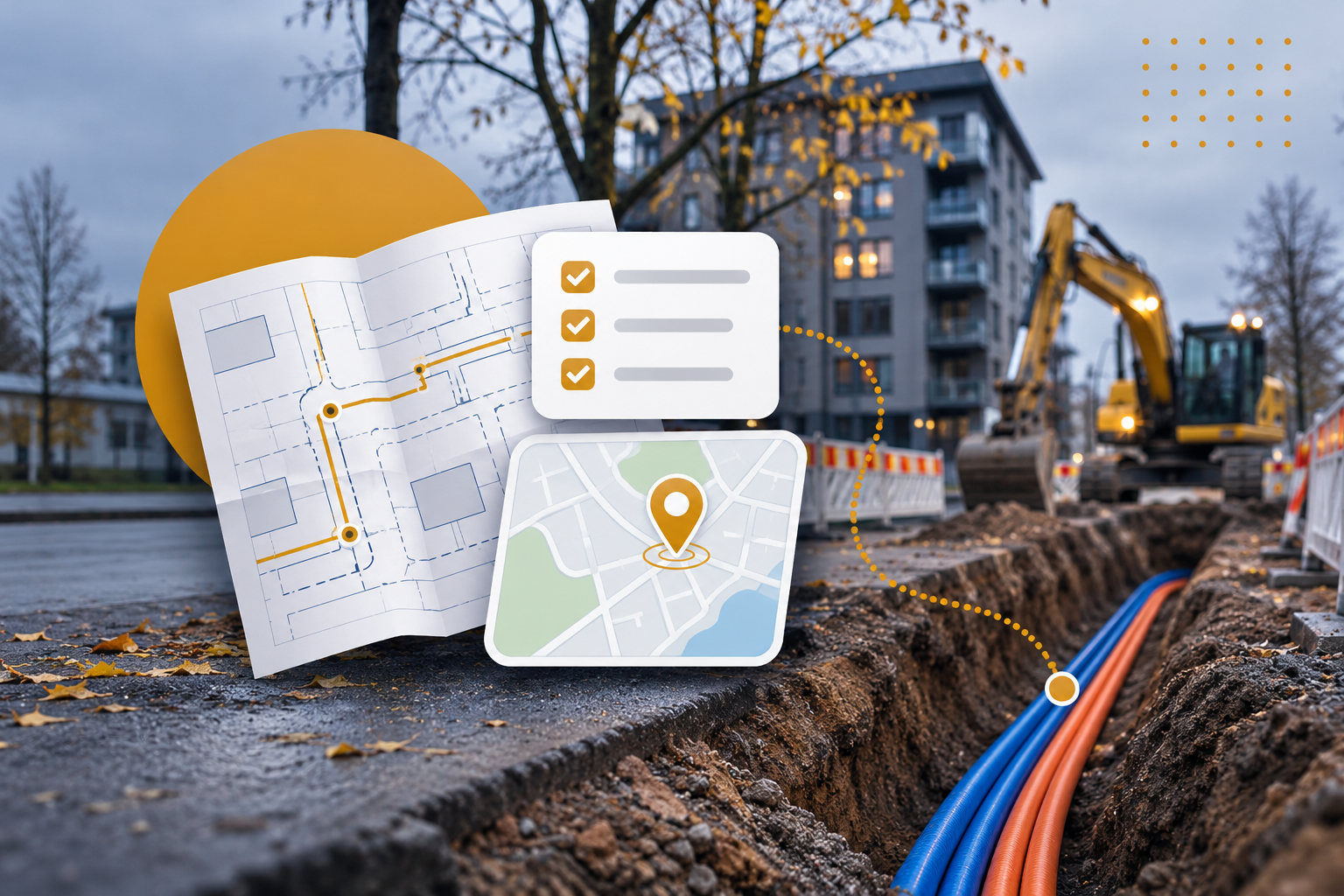
Over the past few years, I have closely followed the rapid growth of fiber-optic network construction in particular and have visited many different infrastructure construction sites. At the same time, I’ve noticed a pattern that repeats itself from one site to the next, regardless of the contractor, the type of project, or the location.
There is more information than ever before, but that information does not always reach the places where decisions are made and where the work is ultimately carried out. Most of the time, the issue is not that the information does not exist. Plans are in place, documents are produced, responsibilities are defined, and changes are communicated. Yet the actual implementation can look completely different from what was agreed upon in the documents.
This inevitably raises the question: Where along the way did the information get lost?
Information does not turn into action on its own
Construction has become increasingly documented. More plans, as-built data, inspections, and reports are being produced than ever before. This is a step in the right direction, and the problem is generally not a lack of information.
On construction sites, one sometimes notices that there isn’t just one reality at a site, but several. The person in charge of the site has an approved plan. The excavation crew works according to it. At the same time, the crew laying the asphalt base—or a subcontractor—is carrying out their part of the work in a completely different way. The justifications are usually familiar: “This is how it’s always been done,” or “This is how they do it in the neighboring municipality.”
The first thought might be that this is a mistake or a lack of expertise. Most often, however, it’s a much more mundane issue. A plan exists, but not all work teams are working based on the same information. Some operate according to the approved plan, while others rely on past experience or old ways of doing things.
However, not all deficiencies observed on construction sites are due to information failing to reach the right people. Sometimes a plan exists, the guidelines are known, and the requirements are clear. Yet on the job site, one encounters an incomplete fence, an unprotected excavation, or traffic arrangements that do not correspond to the approved solution.
In such cases, the issue is no longer a lack of information, but rather why something that was known was not implemented in practice. It is precisely in these situations that one realizes the biggest challenge on a construction site is not necessarily the absence of a plan. The challenge lies in the fact that the approved plan has not been translated into a shared way of working.
The biggest problems often arise from small assumptions
A shortcoming observed on a construction site easily raises the question of who made the mistake. In practice, the situation is rarely that simple. More often than not, it’s a chain of small assumptions. Someone assumes the information has been passed on. Someone else assumes the change has been updated for everyone. A third person assumes the matter has already been checked.
On construction sites, you often hear the phrase: “We’ve talked about this before.”
From an information management perspective, this is an interesting observation. At some point, the information existed. Someone had heard about it. Yet not everyone who is supposed to act on that information has necessarily received the same message.
Sometimes another familiar excuse comes up: “This will be fixed later.”
From the construction site’s perspective, this idea may seem understandable. From a safety or quality standpoint, however, “later” may be too late. Many problems observed on a construction site do not arise as a result of a single major error. It arises from several small assumptions that accumulate in the same area. The end result can be a situation where everyone believes they have acted correctly, but the overall outcome still does not match what was originally intended.
If this same phenomenon begins to recur from one project to the next, it’s worth focusing not on individual mistakes but on how information flows between organizations, contractors, and work teams.
What Can Construction Sites Teach Us About Information Management?
When examining the challenges on construction sites, one observation has recurred year after year. Rarely is a lack of professional skill or a reluctance to do things correctly at the root of the problem. Quite the opposite. Most of the time, the goal on a construction site is to get the job done safely, with high quality, and on schedule.
That is precisely why shortcomings in information flow are so interesting. They generally do not stem from a lack of expertise but from the fact that not all parties are operating on the basis of the same information. When the flow of information breaks down between the client, the general contractor, a subcontractor, or a work team, the consequences are ultimately felt on the job site, regardless of how well the original plan was drawn up.
The challenges observed on construction sites are usually not due to a lack of information, but rather to the quality of the information, its timeliness, or how it is transferred from one party to another. Ultimately, the question is whether the entire implementation chain operates based on the same shared understanding of the situation.
If the client, site management, subcontractor, and work crew have different understandings of what is being done, problems will eventually surface on the job site, regardless of how well the original plan was drawn up. When it comes to challenges observed on construction sites, an interesting question is often whether the information existed but was not passed on, or whether the information existed but was not acted upon.
Just as important as the flow of information during the project is what happens to that information once the work is completed. For the success of a construction site, it is not enough for the information to reach the right people at the right time. The information generated during implementation should also remain accessible, understandable, and usable later on.
Built infrastructure has a long life cycle. Therefore, the importance of as-built data, inspections, and documentation does not end with the completion of the construction site. What is interesting is not only what happened on the construction site, but also whether it will be possible later to demonstrate what was done and why. It is precisely at this point that the importance of information management, documentation, as-built data, and common practices becomes evident in practical work.
Ultimately, the success of a construction site is not determined by the number of documents or the number of systems used in the project. What matters is whether the right information reaches the right person at the exact moment a decision needs to be made, and whether that information is preserved in a format that allows it to be referenced later. On a construction site, safety, quality, and efficiency often stem from the same thing: the fact that the same information flows through the entire implementation chain and remains available even after the work is completed.