Pictue and Infrakit combine their expertise: site photos move automatically from Pictue to Infrakit alongside the rest of the project material.
How can construction sites produce more useful photo documentation without increasing the site management workload? How can photos from different contractors be made available to the whole project with ease? And how can cooperation between two software companies make everyday life on site easier?
Pictue and Infrakit have been looking for answers to these questions together since the summer of 2026. Two experts in their fields joined forces to develop photo documentation and construction project information management as a single whole.
The partnership combines Pictue's easy photo documentation with Infrakit's broader project data management. The integration automatically transfers site photos from Pictue to Infrakit, alongside the rest of the project material.
Two software partners, one shared goal
Infrakit is an information management platform for infrastructure construction, serving projects from design through construction to maintenance. It brings together, among other things, plans, machine control and measurement data, and quality documentation.
In practice, Infrakit works as a shared platform for projects, enabling transparent and efficient operations for customers. The map-based platform has about 11,000 active users.
“Our customers are contractors, cities and municipalities,” says Atte Kajander, Customer Success Manager at Infrakit. He is responsible for part of the company's Finnish customer accounts and helps customers make the most of Infrakit in their daily work.
Alongside Infrakit's own photo feature, site photos can now also be taken with Pictue. The integration transfers the photos, together with their data, straight to the Infrakit platform with the rest of the project material.
“Both companies have invested in making information flow as smoothly as possible on construction sites. By combining our expertise, we can offer customers more flexibility in how they document their work,” says Oskar Smeds, who is responsible for the Infrakit partnership at Pictue.
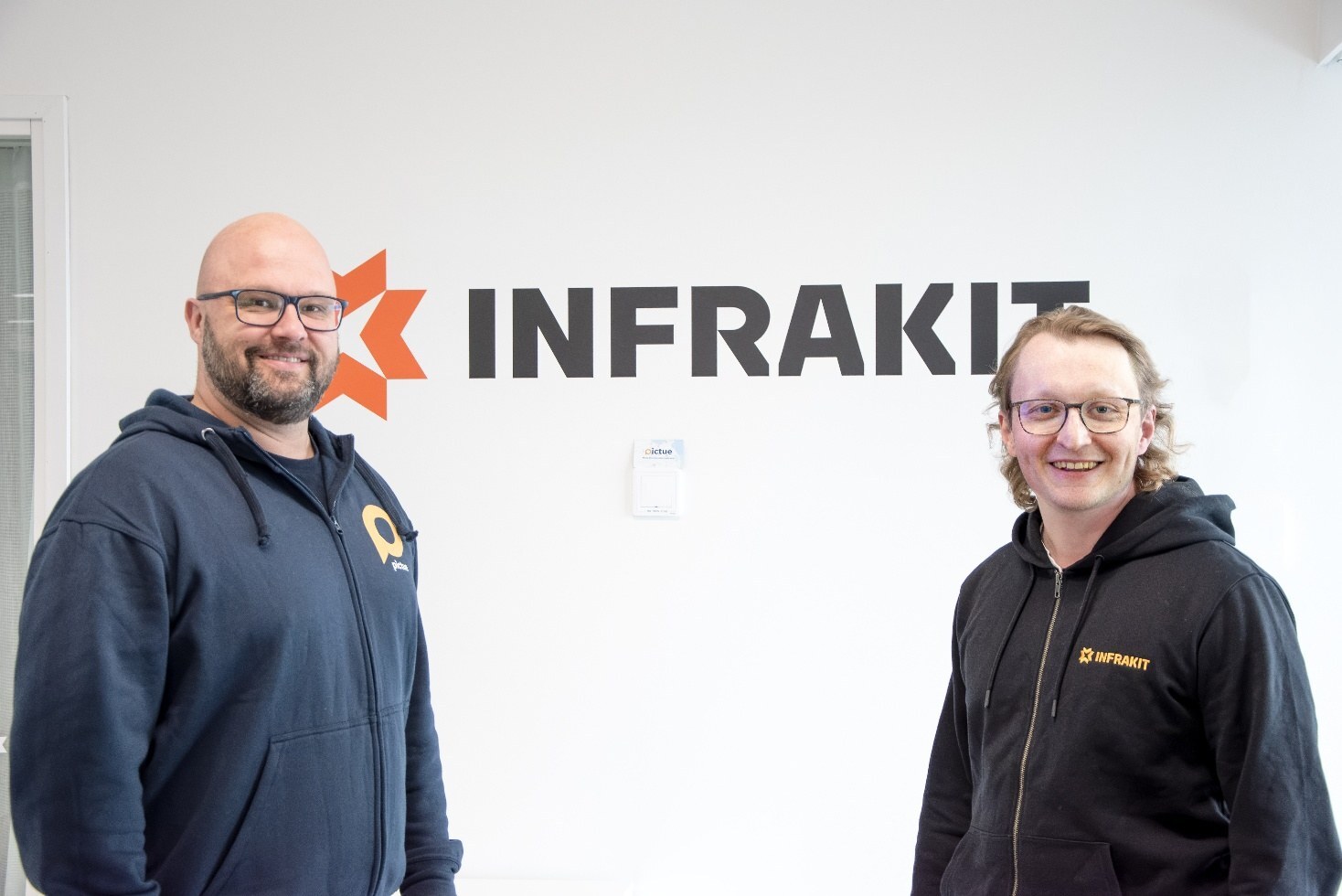
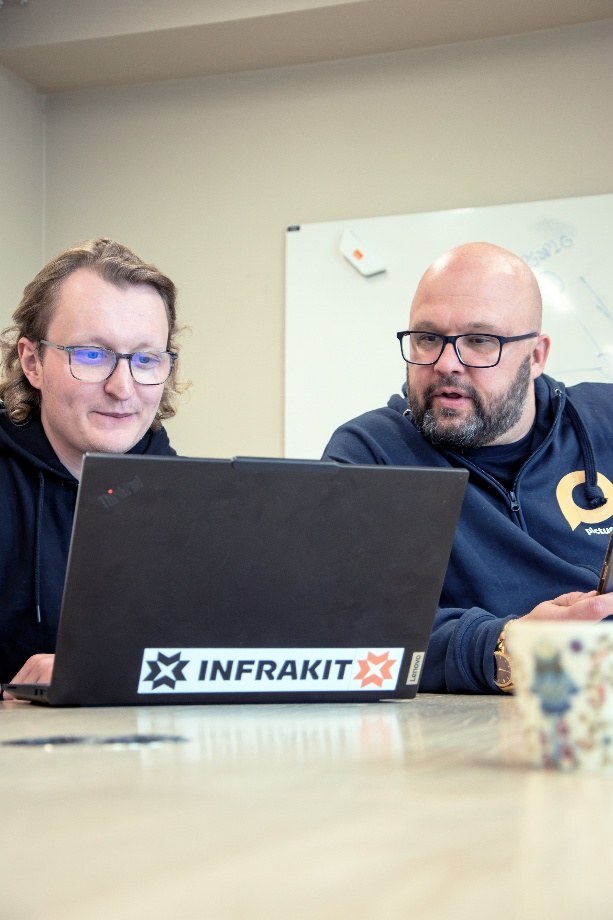
Pictue’s Oskar Smeds and Infrakit’s Atte Kajander have developed the integration between the applications and its customer benefits together. Both see plenty of opportunities in the partnership going forward.
A shared workflow removes unnecessary steps
The cooperation is by no means complicated or multi-step. In its simplest form, a worker takes photos with Pictue, and they then move automatically to Infrakit.
This way, site photos don’t have to be collected separately and passed from one system to another, or saved again by hand. At the same time, photo documentation on site serves the client, the supervisors and the site management as well as possible.
“It is extremely important that all photo documents are in the same place as all the other material. Otherwise, they would have to be searched for in several different systems,” Kajander says.
The photos are transferred together with the photographer’s details, location and time of capture. During onboarding of the integration, it is also possible to define how image files are named so that they are easy to find later.
“Pictue also lets you build keyword paths that are linked to a specific Infrakit folder. This way the material is organised from the start and later handling becomes easier,” Smeds explains.
Complementary expertise gives customers options
Site photos can also be taken with Infrakit. So what added value does the option of using Pictue for photo documentation bring to the customer?
The answer lies in users’ different job roles and established ways of working.
Janne Paitsola, Country Manager for Finland at Infrakit, stresses that connecting the tools customers already use is a key part of the company’s customer promise.
“If part of the work crew is used to working with Pictue, it is definitely good for them to keep using it for photo documentation. We want to make it possible to connect precisely the tools and software our customers use to Infrakit.”
For example, a site manager may need plans, measurement data and information on the progress of the site in the field. Infrakit offers a comprehensive package for viewing and managing them.
“For an installer, on the other hand, a tool focused on photo documentation, like Pictue, may be enough to quickly document the stages of their own work,” Smeds explains.
Smeds believes that being able to choose the tool that suits one’s own work also lowers the threshold for documentation as a whole. At the same time, a larger share of the photos taken on site becomes available for shared use.
Shared material is above all a benefit to the customer
Paitsola points out two purposes of photo documentation: the contractor’s own needs and the quality documentation delivered to the client. In a large project, tens of thousands of photos can accumulate, he says.
“For the contractor, photos are an important tool for developing their own operations and tracking the progress of the work. They also support legal protection when possible deviations have been documented,” Paitsola says.
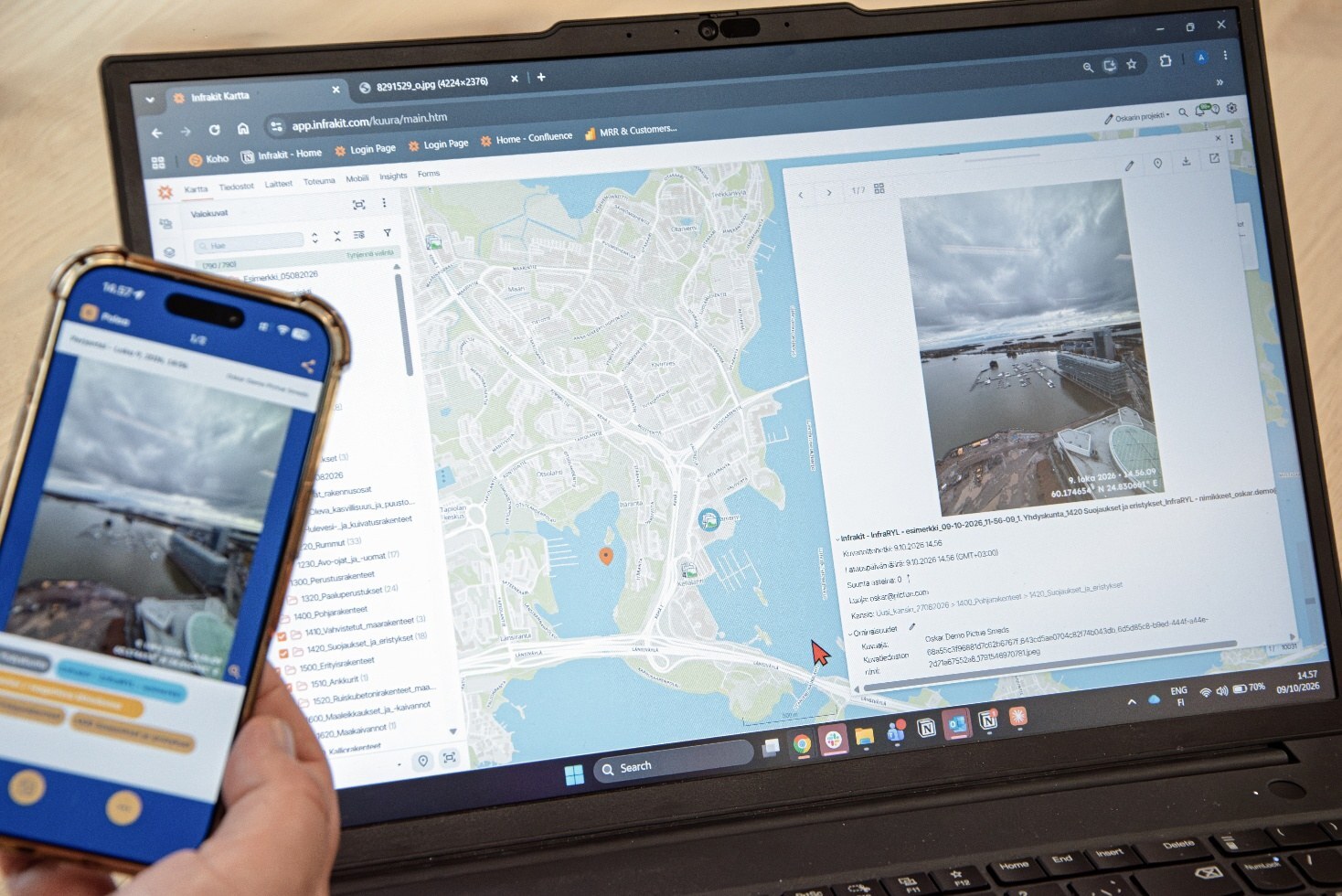
In Infrakit’s map view, the photos you need can be located directly by where they were taken.
Kajander illustrates the benefit with the example of a long, stretched-out site area. Instead of browsing through the whole file list, the search can be targeted on the map straight at the spot whose documentation is needed.
“This way, the few photos the user is looking for are easy to find among thousands of images.”
Photos complement measurement data and other quality documentation by showing the state of a work phase at the moment of capture. They allow site management, supervisors and the client to review the execution even after the structures have been covered.
Once the project is completed, the photos also become part of the handover material. They can be returned to, for example, when sorting out warranty matters and planning maintenance.
Kuortaneen Kaivin gives the client direct access to site photos
The installers and excavator operators of Kuortaneen Kaivin, a company specialising in infrastructure construction, document trenches and different stages of the site with Pictue. Thanks to the integration, the familiar way of taking photos can also be used in projects where the client follows the progress of the work in Infrakit.
According to site manager Tero Piri, a shared project environment is particularly useful when the site has several subcontractors, machines and measuring devices.
“Pictue is a familiar app to our employees, and they know how to use it. Installers and excavator operators take the photos with the app, and through the integration they go straight to the client’s view in Infrakit,” Piri says.
Kuortaneen Kaivin has used Pictue and Infrakit together at, among others, the Jalasjärvi and Kurikka sites. The employees’ way of taking photos has stayed the same – but one work step has been removed for site management.
“I don’t have to move photos anywhere in between; the client sees them in Infrakit in real time,” Piri illustrates.
Pictue’s keyword paths and agreed naming conventions help organise the photo material already at the moment of capture. The photographer chooses which route and which structural part the photo was taken of. This way the photos stay findable as the material grows.
Piri also appreciates how simple photographing is. Feedback from the client’s and supervisors’ representatives has confirmed that the photos reach their destination and the solution works well. Support from both software partners also earns praise.
“Whenever we have had questions, we have received support and help. Big thanks for that to both Pictue and Infrakit.”
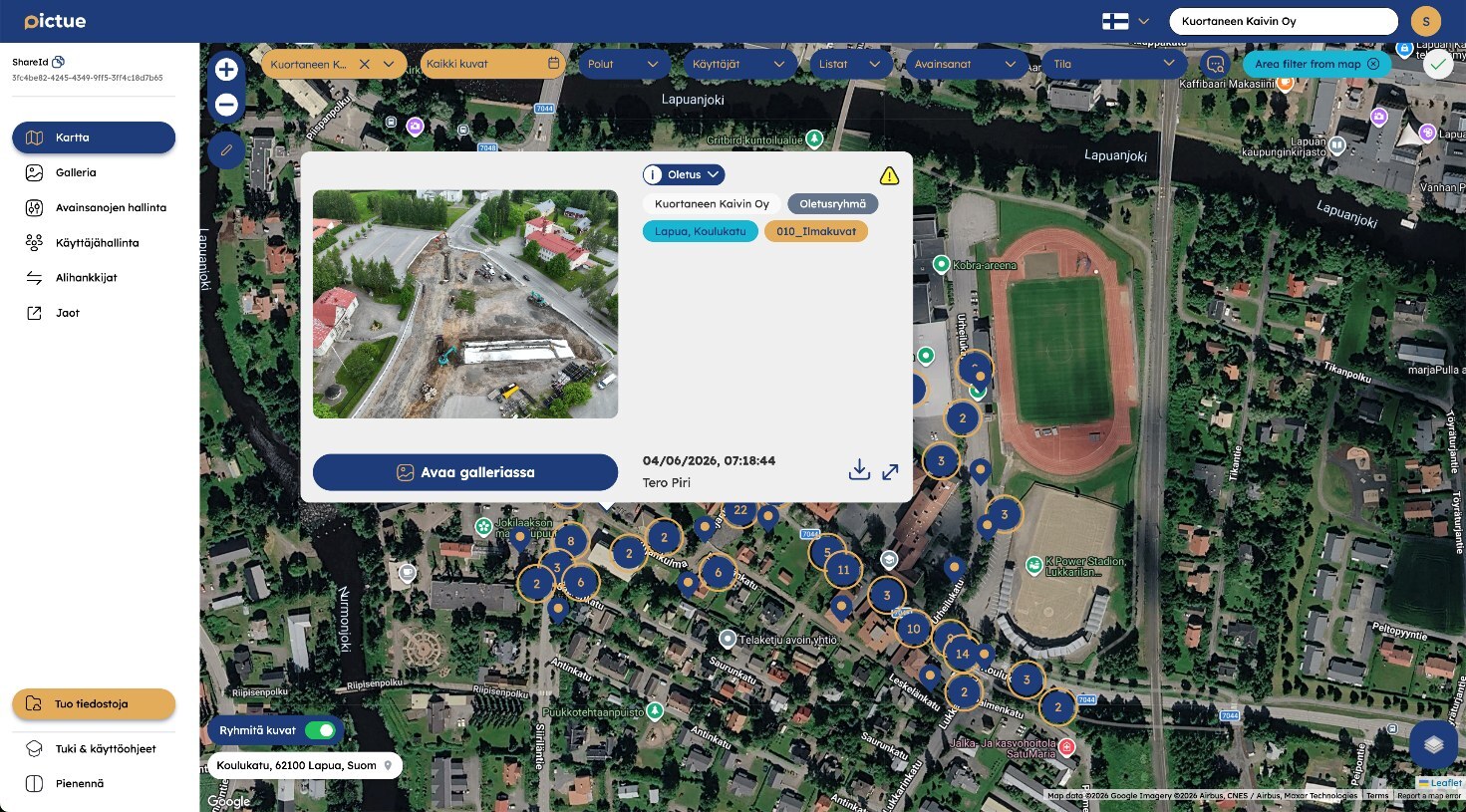
Tero Piri, site manager at Kuortaneen Kaivin, makes use of the location data of Pictue photos when saving drone images to the app. The photos are also placed at the right spot on the map in Infrakit.
The partnership opens up new opportunities
Smeds sees the cooperation offering both companies new opportunities.
Pictue can serve its customers even better in projects where photo material must be delivered together with other project data. Infrakit, in turn, gains a partner focused on photo documentation, which makes collecting information from the field easier.
Kajander also highlights how smoothly the implementation has gone.
“Our cooperation has been really easy and smooth. The integration and the cooperation have been developed with the customer first,” he says.
Both Infrakit and Pictue already operate in international markets. Going forward, the partners aim to grow by taking Finnish expertise ever more widely around the world.
Together, the companies can pursue new customers and offer solutions to projects where their services complement each other.
“For a country of its size, Finland has really good software and engineering expertise. It is worth looking together for ways to take it to the world. Often, through cooperation, one plus one is more than two,” Smeds says.